We have become a preferred partner to leading biofuel refiners, major oil companies, blenders, retailers, and other commodity companies.
We have become a preferred partner to leading biofuel refiners, major oil companies, blenders, retailers, and other commodity companies.
We have become a preferred partner to leading biofuel refiners, major oil companies, blenders, retailers, and other commodity companies.
The Challenge:
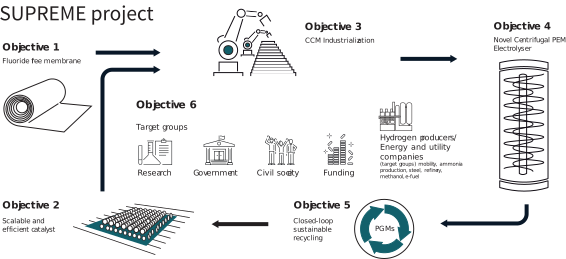
Most commercial electrolysers use "PFSA" membranes (like Nafion™) which belong to the PFAS family of chemicals. These "forever chemicals" face potential bans in the EU due to environmental and health concerns. While fluoride-free (NF) alternatives exist, they haven't yet achieved the high-volume reliability needed to dominate the market.
The SUPREME Research:
-Sustainable Chemistry: We are developing a new membrane based on patented technology from TÜBİTAK that uses stable "sp2–sp2" chemical linkages for superior resilience.
- Hybrid Composites: By blending organic polymers (SPEEK) with advanced fillers like Covalent Organic Frameworks (COFs), we create high-speed "pathways" for protons to move through.
- High-Temperature Performance: These hybrid materials support operations at higher temperatures than traditional fillers, making them more versatile for industrial use.
- Market Guidance: TU Graz is conducting a "head-to-head" comparison of commercial and project-developed membranes to create a definitive ranking list for the industry.


The Challenge:
Current electrolysers rely on expensive and rare metals like Iridium, which are difficult to source and drive up the cost of green hydrogen.
The SUPREME Research:
- Next-Gen Alloys: We are designing specialized alloys—complex metal mixtures that are more stable and efficient than standard materials.
- Slashing Iridium Use: By using advanced computer simulations and ceramic supports, we aim to minimize Iridium without compromise performancet.
- Upscaling Production: We are moving these lab breakthroughs into industrial-scale manufacturing, increasing green hydrogen potential without putting more burden to nature..
- Circular Supply: Our catalysts are designed to be recycled, ensuring a secure and environmentally friendly material loop.
The Challenge:
Most advanced "green" membranes today are made using slow, manual lab processes that cannot be scaled for factories. Additionally, inconsistent testing methods make it nearly impossible to compare performance between different technologies.
The SUPREME Research:
- Industrial Printing: We are moving away from manual lab assembly to a single-step "direct printing" process. This allows us to print sustainable catalyst inks directly onto the membrane at high speeds.
- Bridging the "Valley of Death": By designing our manufacturing for high-throughput production lines from the start, we ensure that lab breakthroughs can actually reach the market.
- Optimized Performance: We are developing a specialized "break-in" protocol specifically for non-fluorinated materials to ensure every unit performs at its peak from day one.
- Standardized Testing: We are establishing new, reproducible test protocols so that performance can be reliably measured and compared across the industry.

The Challenge: In standard electrolysers, gas bubbles often get "stuck" on the catalyst surface, acting like a curtain that blocks the reaction and lowers efficiency. While spinning a stack can solve this, it is historically difficult to scale up and power safely.
The SUPREME Research:
- Spinning for Efficiency: By rotating the electrolyser stack, we use centrifugal force to "flick" bubbles away instantly. This opens up more surface area for the reaction, allowing the system to work harder and more efficiently.
- Wireless Powering: We use a proprietary wireless rotational inductive power transfer (IPT) system. This powers the spinning stack without physical wires, reducing wear and tear and ensuring a steady, efficient energy flow.
- Safe "On/Off" Operation: Our design reduces hydrogen crossover, meaning the system can handle being turned on and off frequently. This makes it perfect for connecting directly to fluctuating renewable energy sources like wind and solar.
- Built to Scale: Unlike previous lab experiments, our centrifugal design is built for the real world—targeting stack sizes of 0.5 MW and upwards for mass manufacturing.
The Challenge: Traditional metal recycling uses massive smelters mperatures over, which are expensive, polluting, and struggle with the specific materials used in hydrogen technology. In particular, recycling Iridium is a major global bottleneck and a significant risk to the hydrogen supply chain.
The SUPREME Research:
- Eco-Friendly Recovery: We are moving away from high-heat smelting toward "hydro-electrochemical" recycling. This process uses less energy, costs less to set up, and is far better for the environment.
- Closing the Loop: By implementing a "closed-loop" system, we ensure that rare metals like Iridium and Platinum are recovered from old electrolysers and sent right back into the production of new ones.
- Precision Separation: Our method allows for the efficient separation of different elements without damaging the surrounding materials, ensuring the recycled metals remain high-quality.
- Immediate Impact: Unlike other projects, we are utilizing SDU’s existing expertise to provide recycled materials to our partners from the very start of the project

The Challenge: Many brilliant laboratory breakthroughs fail to reach the market because they aren't designed for industrial reality—a gap known as the "Valley of Death." Turning a prototype into a commercial product requires a clear strategy, early-user feedback, and a strong business case.
The SUPREME Research:
- Strategic Partnerships: We are building a detailed commercialization roadmap that connects our technical achievements directly to market needs.
- Targeting Early Adopters: Our primary focus is on hydrogen fueling stations. Our technology thrives on "intermittent operation," meaning it can produce hydrogen when electricity prices are lowest without suffering from safety or degradation issues.
- Dual Commercial Paths: We aren't just selling one machine. Partners are commercializing individual breakthroughs—such as new membranes, low-loading catalysts, and advanced manufacturing methods—through licensing and new product portfolios.
- Global Outreach: Led by our industrial partners, we are engaging with end-users in Norway and across Europe to ensure our solutions are "market-ready" from day one.


.webp)