SUPREME project

SUPREME is an international research initiative funded by the Clean Energy Transition Partnership (CETPartnership). Co-funded by the European Union, the CETPartnership brings together public and private stakeholders to foster transnational innovation ecosystems.

Project ID: Cetp-FP-2024-00126
Call topic: CETPartnership Joint Call 2024, TRI3 -CM2024-05
Period: 1. Dec. 2025 – 30. Nov. 2028
Coordinator: University of Southern Denmark
Participants: TÜBİTAK MAM, Graz University of Technology, AMES Goldsmith Ceimig, Element One Energy AS, Fraunhofer ISE

By pooling national and regional funding, the partnership supports breakthrough technologies—like SUPREME's novel water electrolysis technology—required to empower the clean energy transition and make the EU the first climate-neutral continent by 2050.

Impact

Cost impact

Reducing the Green hydrogen production price from €5 to €2 per kg by 2030.

Climate impact

Potential to save 2Mt of CO₂ by 2030 and 500 Mt of CO₂ by 2050.

Technology

Moving from TRL 3 to TRL5 with a novel centrifugal electrolyser of non-fluorinated protonexchange membrane (NF PEM)

Circularity

Closed-loop material circularity for PEM electrolysers, securing 90% recyclability and drastically reducing the dependency on Critical Raw Materials (CRM) such as Iridium.
The Technology

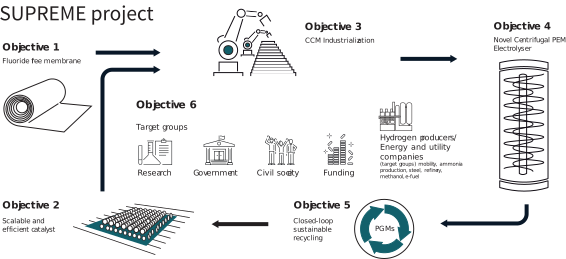
  • Sustainable Materials - Pioneering PFAS-Free Membranes Traditional PEM electrolysers rely heavily on fluorinated membranes (like Nafion), which contain harmful 'forever chemicals' (PFAS) that are facing impending European bans. SUPREME is proactively addressing this by replacing them with state-of-the-art, non-fluorinated (NF) alternatives. These next-generation membranes not only safeguard human health and the environment but are engineered to deliver superior proton conductivity and mechanical stability for long-term, high-performance hydrogen production.
  • Advanced Catalysts - High Entropy Alloys & Optimized CCMs To drastically cut capital costs and resource dependency, we are developing advanced High Entropy Alloy (HEA) catalysts. By integrating these novel materials into highly efficient Catalyst Coated Membranes (CCMs) utilizing scalable manufacturing techniques, we can significantly reduce the loading of expensive Platinum Group Metals (PGMs) like Iridium. This breakthrough approach maintains exceptional durability while boosting catalytic mass activity by over 20%, driving down the overall cost of green hydrogen.o reduce expensive Platinum Group Metal (PGM) loading while increasing activity by 20%.
  • Novel Cell/Stack Design - Centrifugal Electrolysis A major bottleneck in traditional water electrolysis is the buildup of gas bubbles on the electrodes, which blocks reaction sites and lowers efficiency—especially at high production rates. The SUPREME project introduces a game-changing Centrifugal PEM electrolyser. By utilizing rotational force (g-force) to rapidly separate and expel oxygen and hydrogen bubbles, our system unlocks unprecedented efficiency at ultra-high current densities. This design also offers extreme operational flexibility and a high turndown ratio, making it the perfect match for fluctuating renewable energy sources like wind and solar
  • Circular Economy - Closing the Loop on Critical Raw Materials Resource security is vital for the clean energy transition. SUPREME implements a comprehensive closed-loop recycling strategy designed specifically for our novel CCMs and non-fluorinated membranes. By achieving greater than 90% recovery efficiency for Critical Raw Materials (CRMs) such as Iridium and Platinum, we drastically reduce the environmental footprint and lifecycle costs of the electrolyser, ensuring a secure, sustainable, and independent European supply chain.
Explore the technology

The Project

SUPREME addresses the challenges of current PEM electrolysis by eliminating harmful fluorinated polymers and reducing the reliance on expensive critical raw materials like Iridium and PGMs (Platinum group metals).

To dramatically boost efficiency and drive down costs, the SUPREME project introduces centrifugal electrolysis—utilizing a novel rotating electrolyzer design that relies on centrifugal force to rapidly pull gases away from the electrode surfaces, minimizing electrical resistance and maximizing hydrogen output.

Explore the technology